
No, SEO is not part of Performance Marketing.
SEO is a long-term strategy for earning organic traffic, while Performance Marketing uses paid campaigns to generate measurable actions like clicks, leads, or sales.
In this article, you will get a clear and practical understanding of:
- What SEO really means beyond basic definitions and theory
- What Performance Marketing includes in real-world campaigns and business models
- A clear, side-by-side comparison that removes confusion instantly
- Why marketers often mistake SEO for Performance Marketing
- Where SEO and Performance Marketing overlap in real marketing funnels
- Why SEO is NOT officially classified as Performance Marketing
- How successful companies combine both strategies to reduce costs and increase ROI
- Real-world examples that show how both systems work together in practice
- Frequently asked questions that clarify common misunderstanding
SEO vs Performance Marketing (Quick Comparison)
| Factor | SEO | Performance Marketing |
|---|---|---|
| Cost Model | Organic (no cost per click) | Paid per action (CPC, CPA, CPL) |
| Speed of Results | Slow (3–6 months or more) | Immediate (can start today) |
| Sustainability | Long-term digital asset | Stops when budget stops |
| Control Level | Algorithm-dependent | Fully budget-controlled |
| Traffic Type | Organic search traffic | Paid traffic from ads |
| Risk Level | Low financial risk | Requires ongoing investment |
| ROI Tracking | Indirect & long-term | Direct and highly measurable |
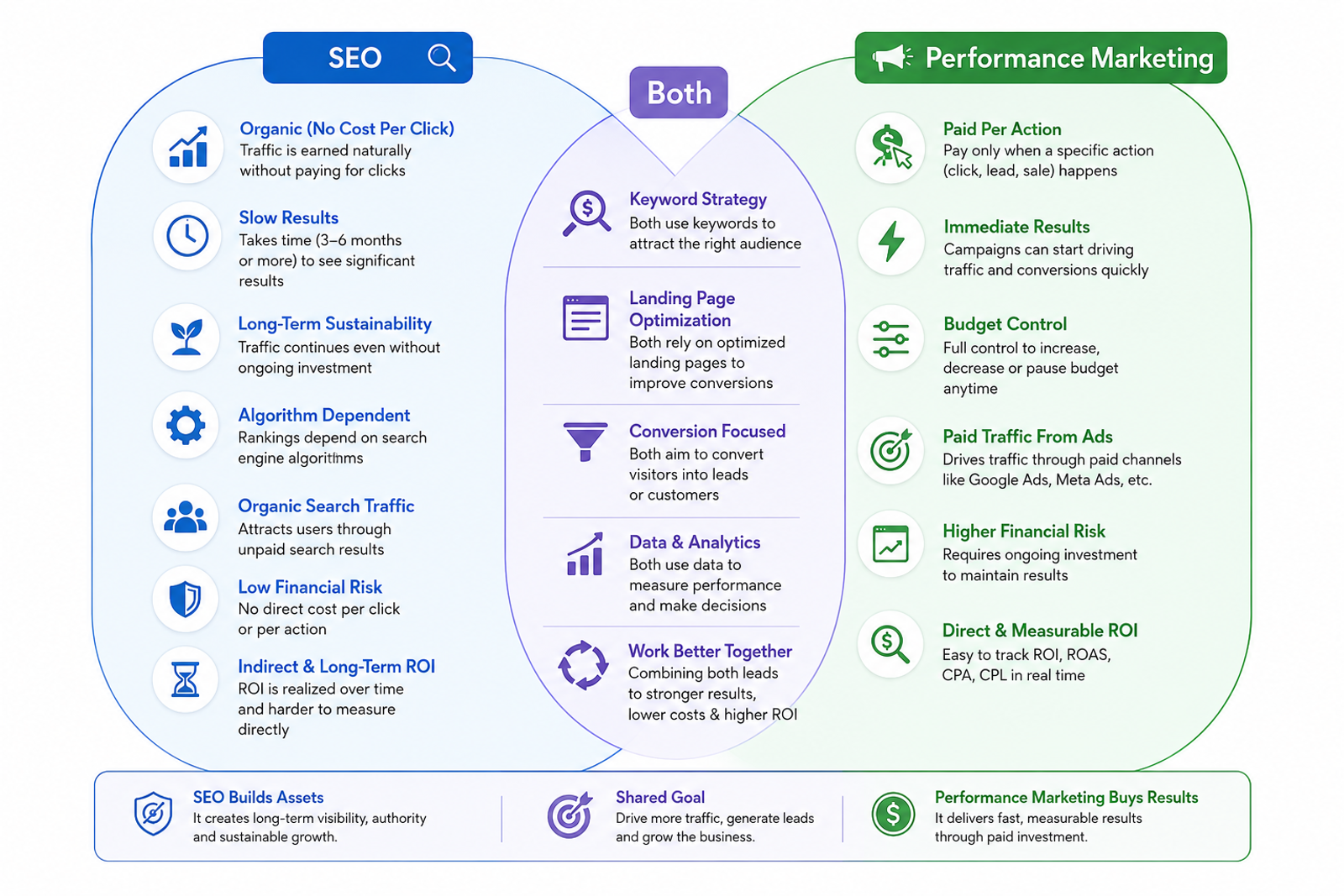
👉 This table shows the fundamental difference: SEO builds assets, Performance Marketing buys results.
What is SEO?
SEO (Search Engine Optimization) is the process of improving a website so that it appears in organic search results on platforms like Google without paying for each visitor.
SEO is not just about ranking higher—it is about building long-term visibility, authority, and trust in search engines so that your website becomes a consistent source of traffic over time.
Search engines evaluate hundreds of signals such as content quality, backlinks, user experience, and technical performance to decide which pages deserve top rankings.
Main Types of SEO
| SEO Type | Main Focus | Key Activities | Main Goal |
|---|---|---|---|
| On-Page SEO | Website content & pages | Keywords, headings, content, internal links, readability | Improve relevance and content quality |
| Technical SEO | Website structure & performance | Crawling, indexing, speed, mobile, technical errors | Make the site easy to crawl and index |
| Off-Page SEO | Website authority | Backlinks, digital PR, brand mentions | Build trust and authority |
1. On-Page SEO
On-page SEO refers to everything you optimize directly inside your content and pages. This includes keyword usage, headings, content structure, and readability.
The goal is to make your content understandable both for users and search engines so that Google can correctly interpret your topic and rank it accordingly.
2. Technical SEO
Technical SEO focuses on the backend and structure of your website. It ensures that search engines can properly crawl, index, and understand your pages.
This includes site speed, mobile optimization, URL structure, indexing issues, and fixing technical errors that could prevent ranking.
3. Off-Page SEO
Off-page SEO is about building authority outside your website. The most important factor here is backlinks from other trusted websites.
When other websites link to your content, Google sees it as a trust signal, which improves your rankings and domain authority over time.
What is Performance Marketing?
Performance Marketing is a digital marketing model where businesses only pay when a measurable action takes place.
Instead of paying for visibility or impressions, companies pay for real results such as clicks, leads, purchases, or sign-ups.
This makes Performance Marketing highly measurable, scalable, and focused on direct ROI rather than long-term brand building.
Common Performance Marketing Channels
Performance Marketing usually runs through paid digital channels such as Google Ads, Meta Ads (Facebook and Instagram), TikTok Ads, and affiliate networks.
These platforms allow advertisers to target specific audiences, control budgets precisely, and measure every action in real time.
Key Features of Performance Marketing
1. Pay-for-Results Model
You only pay when a user takes a specific action. This could be a click, a form submission, or a completed purchase.
2. Fast Execution and Results
Unlike SEO, performance campaigns can start generating traffic and conversions almost instantly after launching.
3. Full Control Over Budget
Advertisers can increase or decrease spending at any time, making it highly flexible compared to organic strategies.
4. Deep Performance Tracking
Every click and conversion is tracked, allowing marketers to calculate exact ROI, ROAS, and cost per acquisition.
Is SEO Part of Performance Marketing?
The simple and correct answer is: No, SEO is not part of Performance Marketing.
These two belong to different marketing categories with different logic:
- SEO focuses on organic visibility and long-term growth
- Performance Marketing focuses on paid acquisition and immediate results
Although they support the same business goals, their mechanisms are fundamentally different.
Why SEO is NOT Performance Marketing (Diffrences)
There are several important reasons why SEO is not classified as Performance Marketing:
1. No Direct Payment Per Action
In SEO, you do not pay for clicks, impressions, or conversions. Traffic is earned organically rather than purchased.
2. No Guaranteed Rankings or Results
Search engine rankings are not guaranteed. Even high-quality content may take time to rank or may never reach the top depending on competition and algorithms.
3. Long-Term Time Horizon
SEO is a slow process. It often takes several months before significant traffic or rankings are achieved.
4. Algorithm Dependency
SEO performance is controlled by search engine algorithms, not by advertising budget or bidding strategies.
Why People Confuse SEO with Performance Marketing
Even though they are different, many marketers confuse them for several reasons:
1. Both Appear in Google Search Results
SEO and Google Ads both appear on the same search results page, making them seem like part of one system.
2. Both Aim for Business Growth
Both strategies aim to increase traffic, leads, and sales, which creates overlap in their perceived purpose.
3. Both Are Data-Driven
Both SEO and Performance Marketing rely heavily on analytics tools like Google Analytics and Search Console to measure performance.
Where SEO and Performance Marketing Overlap
Although SEO and Performance Marketing are different disciplines, in modern digital marketing they are deeply interconnected. The most successful brands do not treat them as separate channels; instead, they combine both strategies to maximize visibility, generate qualified traffic, and improve business results.
1. Conversion Optimization (CRO)
Both SEO and Performance Marketing ultimately pursue the same objective: converting visitors into customers.
Generating traffic alone is not enough. Whether users arrive through organic search or paid campaigns, businesses need to optimize every touchpoint to increase conversion rates.
This includes:
- Improving landing page design and usability
- Creating clear and compelling calls-to-action (CTAs)
- Enhancing page loading speed
- Simplifying forms and checkout processes
- Building trust through testimonials, reviews, and social proof
- Optimizing mobile user experience
Performance marketers often run A/B tests to discover which page elements convert best, while SEO teams use user behavior data such as bounce rate, time on page, and engagement metrics to improve content and page performance. Together, these efforts create a better user experience and higher conversion rates.
2. Keyword Strategy and Search Intent
Keywords are the foundation of both SEO and Performance Marketing, but each channel uses them differently.
SEO Perspective
SEO focuses on building long-term authority around keywords. It targets:
- Informational keywords
- Commercial investigation keywords
- Transactional keywords
- Long-tail keyword opportunities
The goal is to rank organically and capture sustainable traffic over time.
Performance Marketing Perspective
Paid campaigns allow marketers to immediately test:
- Keyword demand
- Search intent
- Conversion potential
- Cost per acquisition (CPA)
- Market competitiveness
Because paid campaigns generate data quickly, marketers can identify high-performing keywords and incorporate them into their SEO strategy.
Likewise, SEO can uncover valuable long-tail keywords that may be cheaper and more profitable in paid campaigns.
This creates a powerful feedback loop for keyword intelligence, where each channel continuously improves the other.
3. Landing Page Optimization
No matter how much traffic a company generates, success depends heavily on the effectiveness of its landing pages.
Both SEO and Performance Marketing rely on landing pages that:
- Match user intent
- Deliver relevant information
- Provide a seamless user experience
- Load quickly on all devices
- Encourage users to take action
A well-optimized landing page improves:
- Conversion Rate (CVR)
- Quality Score in Google Ads
- User engagement metrics
- Organic rankings
- Return on Ad Spend (ROAS)
In many organizations, the same landing pages are used for both organic and paid traffic, making collaboration between SEO and Performance teams essential.
4. Data Sharing and Audience Insights
SEO and Performance Marketing generate valuable user data that can strengthen overall marketing efforts.
Performance campaigns provide insights such as:
- High-converting audiences
- Geographic performance
- Demographic data
- Customer acquisition costs
- Device preferences
SEO contributes insights such as:
- Search trends
- User questions and interests
- Content engagement
- Emerging market opportunities
Combining these datasets helps businesses make more informed decisions and allocate budgets more effectively.
5. Brand Visibility and Search Dominance
When a company appears in both organic and paid search results simultaneously, it increases:
- Brand credibility
- Search visibility
- Click-through rates (CTR)
- Market share on the search engine results page (SERP)
Studies consistently show that users are more likely to trust and engage with brands that dominate multiple positions on the search results page.
This strategy is often called SERP domination, where SEO and paid advertising work together to maximize visibility.
SEO in the Marketing Funnel
Modern marketing funnels integrate both SEO and Performance Marketing at different stages of the customer journey. Each channel supports users based on their intent and readiness to purchase.
Top of Funnel (TOFU) – Awareness Stage
At the awareness stage, users are trying to understand a problem or learn about a topic.
The Role of SEO
SEO plays a crucial role by attracting users through:
- Educational blog posts
- Guides and tutorials
- Informational articles
- Videos and resource pages
- Industry research and insights
The primary objective is to:
- Increase brand awareness
- Generate new traffic
- Build authority and trust
- Introduce potential customers to the brand
The Role of Performance Marketing
Paid campaigns at this stage typically focus on:
- Display advertising
- Video campaigns
- Social media awareness campaigns
- Broad audience targeting
The goal is to expand reach and introduce the brand to new audiences.
Middle of Funnel (MOFU) – Consideration Stage
At this stage, users know their problem and are actively researching solutions.
SEO Activities
- Comparison pages
- Product reviews
- Case studies
- Best practices content
- Industry reports
- Solution-focused articles
Performance Marketing Activities
- Retargeting campaigns
- Lead generation ads
- Email nurturing campaigns
- Audience segmentation campaigns
The objective is to:
- Build trust
- Educate prospects
- Address objections
- Position the brand as the best solution
Both SEO and Performance Marketing work together here to move users closer to a purchasing decision.
Bottom of Funnel (BOFU) – Conversion Stage
At this stage, users have high purchase intent and are ready to take action.
Performance Marketing Dominates Through:
- Google Search Ads
- Remarketing campaigns
- Dynamic product ads
- Shopping campaigns
- Promotional offers and discounts
SEO Supports Conversion Through:
- Product pages
- Service pages
- Pricing pages
- Brand-specific keywords
- Transactional content
The main objective is to:
- Generate leads
- Drive sales
- Increase conversions
- Maximize revenue
This is where both channels contribute directly to business growth and return on investment.
Strategies That Make SEO and Performance Marketing Work Better Together
SEO and performance marketing should not operate as separate marketing activities. When managed together, each channel can provide data and opportunities that improve the performance of the other.
A practical strategy is to use a test, learn, optimise and scale approach.
1. Use Performance Marketing to Test the Market
Paid campaigns can be used to quickly test:
- Which keywords generate qualified leads
- Which services have the highest conversion rates
- Which locations produce the best customers
- Which ad messages attract the most clicks and enquiries
- Which landing pages convert visitors most effectively
This allows businesses to collect real customer and conversion data much faster than waiting for an SEO campaign to rank.
2. Use Conversion Data to Guide SEO
Once performance marketing identifies keywords and services that generate valuable leads, these insights can be used to prioritise SEO work.
For example, if a Google Ads campaign shows that a specific service keyword generates a strong conversion rate, the business can:
- Create or improve an SEO landing page targeting that service
- Develop supporting content around related search queries
- Improve internal links to the commercial page
- Optimise the page for local search intent
- Build authority around the topic over time
This reduces the risk of investing months in SEO content that attracts traffic but generates little commercial value.
3. Use SEO Data to Improve Paid Campaigns
The relationship also works in the opposite direction. SEO data can reveal:
- New keywords customers are searching for
- Questions and topics generating organic traffic
- Pages with strong engagement
- Locations with growing search demand
- Search terms that attract highly relevant visitors
These insights can be used to create new Google Ads campaigns, improve ad copy and identify additional commercial opportunities.
4. Use Paid Marketing While SEO Builds Authority
SEO results usually take time. During this period, paid advertising can provide immediate visibility for important services and locations.
This creates a practical growth strategy:
Paid advertising generates immediate traffic and conversion data → SEO uses that data to build long-term organic visibility → Organic traffic reduces dependence on paid clicks → Paid campaigns are then focused on the most profitable opportunities.
5. Retarget Visitors from Both Channels
Businesses can also combine SEO and paid traffic through remarketing.
For example, a visitor may first discover a business through an organic search result but leave without making contact. That visitor can later be reached through remarketing campaigns with:
- A relevant service offer
- A quote request
- A seasonal promotion
- Customer reviews
- A reminder to complete an enquiry
The same strategy can be applied to visitors who initially arrive through paid advertising but do not convert.
6. Build a Continuous Marketing Feedback Loop
The most effective strategy is to create a continuous feedback loop between both channels:
Paid campaigns → Conversion data → SEO priorities → Organic traffic → Audience insights → Better paid campaigns → More qualified traffic and conversions
For example, a Melbourne service business might use Google Ads to discover that searches for a specific service in a particular suburb generate a high number of enquiries. The business can then create a dedicated local SEO landing page targeting that opportunity, support it with relevant content and internal links, and continue using paid advertising to target high-value searches while the organic page builds authority.
Over time, this approach allows both channels to become more efficient. Performance marketing provides speed, testing and measurable conversion data, while SEO builds long-term visibility and reduces reliance on continuously paying for every website visit.
Rather than treating SEO and performance marketing as competing strategies, businesses should use paid campaigns to discover what works, SEO to build sustainable visibility around proven opportunities, and data from both channels to continually improve the overall marketing strategy.
FAQ
Is SEO part of digital marketing?
Yes, SEO is one of the core pillars of digital marketing alongside paid ads, social media, and email marketing.
Is SEO free?
SEO traffic is technically free, but it requires investment in content creation, optimization, and time.
Which is better: SEO or Performance Marketing?
Neither is better on its own. The strongest results come from combining both strategies.
Can SEO replace paid ads?
Not in the short term. SEO is a long-term strategy, while ads provide immediate results.
Does SEO generate ROI like ads?
Yes, but SEO ROI is slower to appear and compounds over time, making it more sustainable.
Final Conclusion
SEO is not part of Performance Marketing, but it plays a critical supporting role in modern digital growth strategies.
The most successful companies do not choose between them—they integrate both.
SEO builds long-term digital assets and authority, while Performance Marketing delivers fast, measurable, and scalable results.
Together, they form a complete and powerful growth system.

Amin Ghenati is an SEO Specialist at Web Like Web with hands-on experience in keyword research, on-page optimisation and organic growth strategies.
