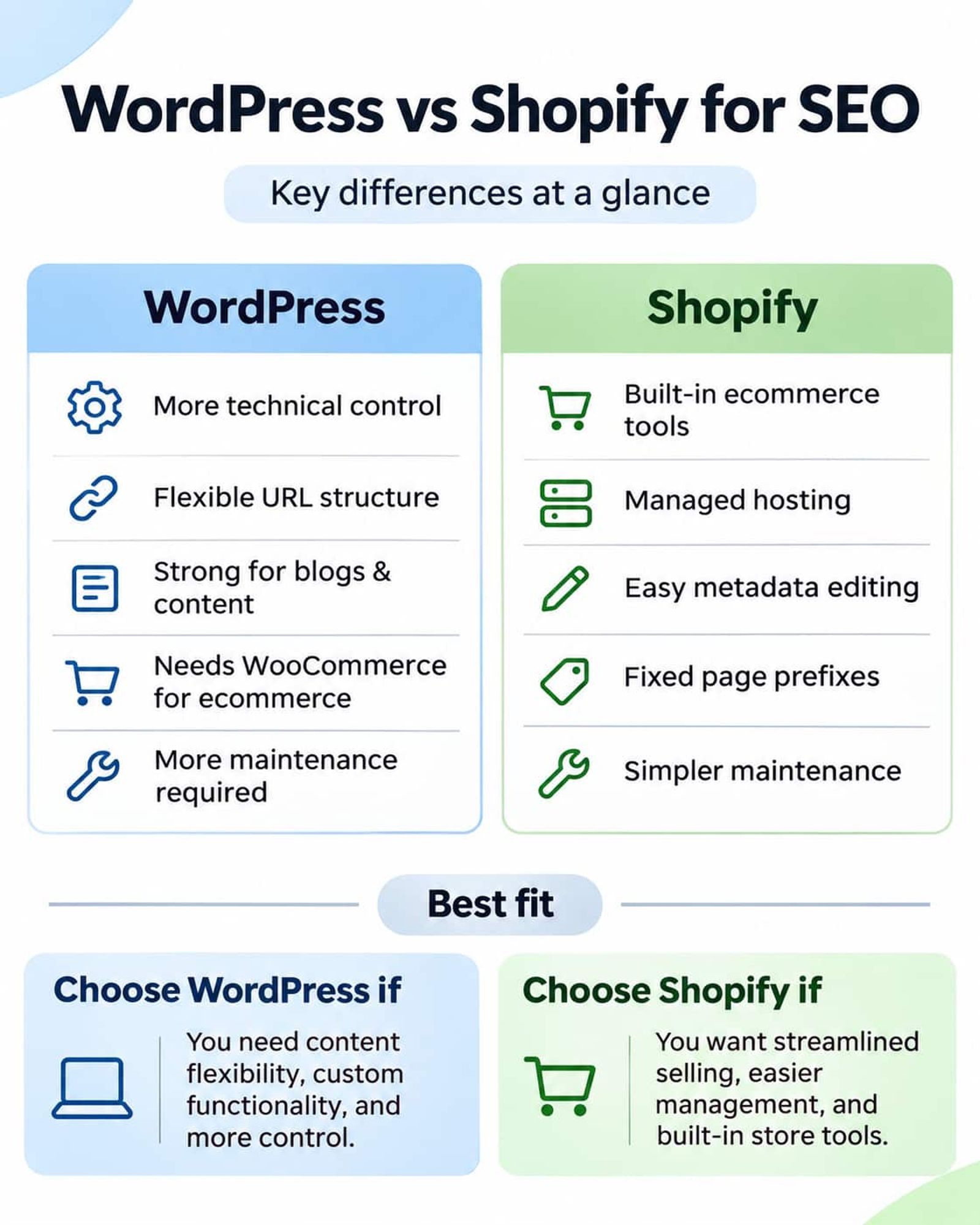
Both WordPress and Shopify can support strong search engine rankings, but they take different approaches to SEO. WordPress offers greater flexibility over technical settings, content structure, and customisation, while Shopify provides built-in ecommerce tools and simpler maintenance. Choosing between them depends on your business model, SEO strategy, technical resources, and long-term goals rather than which platform is inherently better for Google.
WordPress vs Shopify for SEO: Quick Comparison
| SEO Feature | WordPress | Shopify |
|---|---|---|
| Technical SEO control | Extensive control through plugins, code, and hosting | Built-in features with some platform restrictions |
| On-page SEO | Highly customisable with SEO plugins | Built-in metadata and content editing |
| URL structure | Flexible permalink configuration | Fixed prefixes for key page types |
| Content management | Excellent for blogs and complex content | Suitable for blogs and ecommerce content |
| Ecommerce SEO | Requires WooCommerce or another ecommerce solution | Ecommerce features built into the platform |
| Website speed | Depends on hosting, themes, and configuration | Managed hosting and CDN infrastructure |
| Structured data | Available through plugins or custom development | Supported by themes, apps, and custom code |
| Maintenance | Updates, security, and hosting require management | Most infrastructure maintenance is handled |
| Best suited for | Content-heavy and highly customised websites | Businesses prioritising streamlined online selling |
The comparison focuses on self-hosted WordPress, with WooCommerce for ecommerce. WordPress.com hosting plans can have different restrictions and management requirements.
Technical SEO and Site Structure
WordPress: Greater Technical Flexibility
WordPress gives website owners extensive control over technical SEO. Depending on hosting and configuration, businesses can customise robots.txt rules, canonical tags, XML sitemaps, indexing settings, and site architecture. Plugins such as Yoast SEO and Rank Math simplify many of these tasks without requiring extensive coding.
However, flexibility also creates responsibility. Poorly configured plugins, complicated themes, hosting limitations, or conflicting SEO settings can affect crawling and indexing. WordPress performs best when its technical foundation is regularly reviewed and maintained.
Shopify: Built-In SEO Infrastructure
Shopify automatically generates XML sitemaps, canonical tags, and robots.txt files. It also provides managed hosting and SSL certificates, reducing the technical work required to launch and maintain an ecommerce website.
Shopify supports advanced changes through theme code, apps, and its robots.txt.liquid template, but certain platform-level behaviours remain restricted. Businesses requiring unusual site structures or extensive custom functionality may find WordPress more adaptable.
On-Page SEO and Content Management
WordPress is particularly suitable for content-driven SEO strategies. Its publishing system supports detailed articles, landing pages, custom content types, and complex category structures. SEO plugins make it easier to manage metadata, content previews, internal linking recommendations, and other optimisation settings.
Shopify also allows users to optimise page titles, meta descriptions, headings, image alt text, and written content. Its blogging functionality supports standard content marketing, although WordPress generally offers more options for advanced editorial workflows and custom content organisation.
For businesses relying heavily on educational articles, resource centres, or topic clusters, WordPress may provide a more flexible foundation. For stores publishing product guides alongside their catalogues, Shopify's content tools may be sufficient.
URL Structure and Redirect Management
URL flexibility is one of the clearest differences in the WordPress vs Shopify for SEO comparison.
WordPress allows users to configure permalink structures for posts and other content types. Additional customisation is available through plugins and development. This flexibility helps businesses organise URLs around their content hierarchy, although existing URLs should not be changed without a clear reason.
Shopify uses predefined paths for important page types, including:
- Product pages: /products/product-name
- Collection pages: /collections/collection-name
- Standard pages: /pages/page-name
Store owners can change individual URL handles but cannot freely remove these standard prefixes in a conventional Shopify store.
Both platforms support permanent redirects. Shopify provides built-in redirect management, including import and export options, while WordPress can manage redirects through plugins or server configuration. Shopify also has restrictions on redirecting active URLs and certain reserved paths.
For additional guidance, see the official WordPress permalink documentation and Shopify redirect documentation.
Ecommerce SEO: Shopify or WordPress?
Shopify for Ecommerce SEO
Shopify is designed specifically for online selling. Product management, collections, inventory, checkout, and payment integrations work within one ecommerce platform. This makes it convenient for businesses that want to concentrate on product optimisation and sales rather than managing separate systems.
Shopify also allows businesses to optimise collection descriptions, product metadata, and internal links. However, stores still need a strategy for duplicate or similar product content, filtering, product variants, and collection page optimisation.

WordPress with WooCommerce
WordPress becomes an ecommerce platform through WooCommerce or another selling solution. WooCommerce supports product categories, attributes, variations, and custom store functionality, while WordPress provides extensive control over supporting content.
This combination can be particularly useful for businesses that require complex product structures or substantial educational content alongside ecommerce. However, WooCommerce stores also require hosting, security, plugin compatibility, and performance management.
When deciding between Shopify or WordPress for ecommerce, consider the complexity of your product catalogue, available technical support, and how important customisation will be as your business grows.
Website Speed, Plugins, and Structured Data
Performance and Maintenance
Shopify manages much of its hosting infrastructure, which reduces the work involved in server administration. However, large images, unnecessary apps, and inefficient themes can still affect page speed.
WordPress performance depends more heavily on the hosting provider, theme, caching, plugins, and site configuration. A properly optimised WordPress website can perform very well, but that performance requires appropriate technical decisions.
Google's page experience guidance confirms that Core Web Vitals contribute to its ranking systems, but good performance scores alone do not guarantee higher rankings.
SEO Apps, Plugins, and Structured Data
WordPress provides access to a broad plugin ecosystem for SEO, performance optimisation, redirects, and structured data. These tools offer flexibility but should be selected carefully to avoid unnecessary complexity or conflicting functionality.
Shopify supports structured data through its themes and apps, with additional customisation possible through Liquid templates. Shopify-supported themes include common ecommerce structured data, although individual implementations should still be tested.
Google recommends using appropriate Product structured data to help search engines understand details such as pricing and availability. Both platforms can implement this information, but eligibility for enhanced search appearances does not guarantee that Google will display them.
Which Platform Is Better for Your Business?
Small Businesses and Service Providers
WordPress is often a practical choice for service businesses that depend on local SEO, landing pages, and informational content. It supports flexible website structures and can grow alongside a more complex content strategy.
Shopify becomes more attractive when selling physical products is the main business objective and a streamlined store management experience is important.
Growing Ecommerce Stores
Shopify is well suited to growing stores that want integrated ecommerce functionality with less responsibility for managing hosting and platform infrastructure.
WordPress with WooCommerce may be preferable when a business needs specialised integrations, highly customised shopping experiences, or greater control over its website architecture.
Content-Driven Websites
WordPress generally has an advantage in editorial flexibility. Publishers, professional service firms, and businesses building extensive resource libraries can benefit from its custom content types and publishing options.
Shopify remains capable of supporting content marketing, particularly when articles are designed to attract customers to product and collection pages.
Migrating Between WordPress and Shopify: SEO Considerations
Moving between platforms can affect organic search visibility, especially when URLs, internal links, or page templates change. A migration should preserve important content and make it easy for search engines to identify where pages have moved.
Before migrating, businesses should:
- Audit existing URLs: Identify important pages, organic traffic sources, and backlinks.
- Map redirects: Create appropriate permanent redirects from old URLs to equivalent new destinations.
- Check canonical tags: Ensure important pages reference the intended canonical URLs.
- Update internal links and sitemaps: Replace outdated links and submit the new XML sitemap through Google Search Console.
- Monitor performance: Track indexing, crawl errors, rankings, and organic traffic following launch.
Shopify's predefined URL structure is particularly important when migrating from WordPress because existing product and category URLs may need to change.
Google's official site migration documentation recommends planning URL mappings carefully and maintaining permanent redirects for at least one year where possible. Temporary ranking fluctuations can occur, and no migration can guarantee unchanged search performance.
WordPress vs Shopify: Which Should You Choose?
The best platform depends on how your business operates and where you want to invest your resources.
Choose WordPress when content publishing, technical SEO flexibility, custom functionality, and control over website architecture are central to your strategy.
Choose Shopify when ecommerce operations, integrated selling tools, predictable maintenance, and ease of management are higher priorities.
Neither platform automatically improves rankings. Search visibility still depends on useful content, appropriate technical implementation, effective internal linking, website usability, and ongoing optimisation.
Frequently Asked Questions
Is WordPress better than Shopify for SEO?
WordPress generally offers more technical flexibility and content management options, but this does not make it automatically better for rankings. Shopify provides many essential SEO features without requiring the same level of technical maintenance.
Does Shopify have good SEO capabilities?
Yes. Shopify supports editable metadata, XML sitemaps, canonical tags, product optimisation, and structured data. Its main limitations concern advanced customisation and certain URL structures.
Is Shopify or WordPress better for ecommerce beginners?
Shopify is often easier for beginners who want to launch an online store without managing hosting and software maintenance. WordPress with WooCommerce offers more customisation but can require additional technical knowledge.
Can I migrate from WordPress to Shopify without losing SEO?
A carefully managed migration can reduce SEO risks, but it cannot eliminate them. URL mapping, redirects, canonical tags, content preservation, and post-launch monitoring are essential.
Can WordPress and Shopify achieve similar Google rankings?
Yes. Both platforms can compete for the same search queries. Google does not automatically favour one platform over the other; the quality, relevance, accessibility, and overall implementation of individual websites matter more.
Improve Your Website SEO with WebLikeWeb
Choosing between WordPress and Shopify is only the beginning. The right SEO strategy should address your website's technical condition, content opportunities, and commercial objectives.
WordPress SEO Services
If your website runs on WordPress, WebLikeWeb can help identify technical issues, improve content structure, optimise SEO plugin settings, and strengthen organic search performance.
Explore our WordPress SEO services to discover opportunities for improving your website.
Shopify SEO Services
For ecommerce businesses using Shopify, WebLikeWeb offers platform-specific SEO support covering product and collection optimisation, structured data, technical audits, and website performance.
Explore our Shopify SEO services to build a search strategy suited to your online store.